QoS
Architecture | QoS
Traffic Studies and Engineering
QoS
aware Applications and User Services |
Distributed QoS Measurements
QoS Architecture:
Contents:
- General approach
- Resource Control Layer
- Reservation request scenario
- Multi Domain Aspect
| General approach The general AQUILA network architecture is based on the DiffServ network concept. The objective of the project is to provide dynamic control to QoS based traffic. To do so, a new layer for controlling the network resources is added above the DiffServ network. This Resource Control Layer (RCL) maintains the distribution of network resources between different network entities, especially the network access points. So it can be assured, that the underlying IP network can provide the assumed Quality of Service for the specific network services. The technical approach taken by the project integrates all relevant aspects for future integrated services networks based on the Internet. Therefore it covers economical aspects, technological concepts, aspects of network planning and analysis, aspects of network service creation and administration as well as aspects of end-user service provision. For all these aspects, the project applies a common philosophy of taking the best available concepts and technologies, integrating them into a holistic view of future telecommunication services and providing tools for migration from the current to the future situation. In terms of networking technology, the project assumes the DiffServ architecture as the most promising starting point for its work. On top of this technology, a hierarchically structured Resource Control Layer is built, which applies admission control and resource management to the network. Dynamic adaptation of resource allocation to user requests enables the overall architecture to scale to very large networks. For end-user applications, the project attempts to make its infrastructure available to a large class of already existing applications based on Internet technology. So the project will not attempt to develop end-user applications "from the scratch", but will instead develop a toolkit, which can be used to make existing applications aware of the QoS capabilities of the underlying network. The usability of the toolkit for migration and adaptation of applications will be demonstrated by developing applications to be used in the trial phases.
|
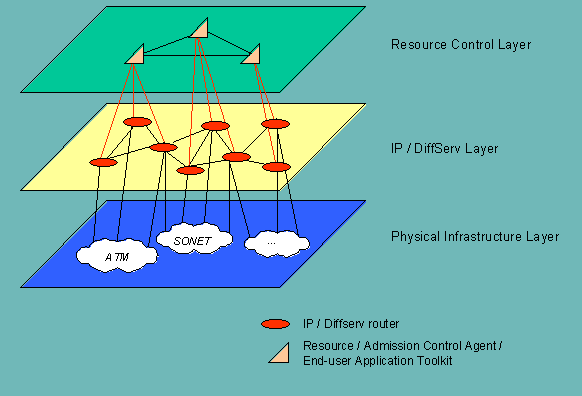 |
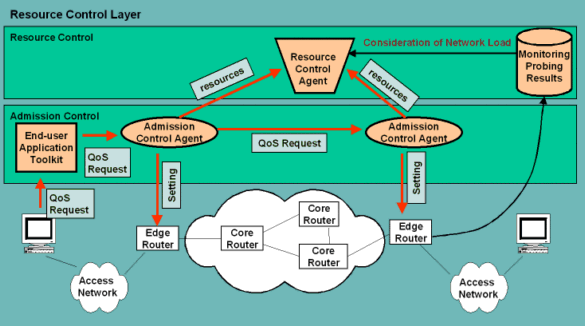
| Resource Control Layer The RCL is responsible for the management of QoS resources inside the AQUILA network. This can be split in three main tasks, which are assigned to different logical entities:
End-users access the Resource Control
Layer by using the End-user Application Toolkit. The EAT does not
constitute a new signalling protocol for IP networks. Instead, it
can be described as a QoS middleware that brings the functionality
of the Resource Control Agents Network into the end-user terminals
and servers. The internal signalling protocol used between user
terminals and the main network can be based on existing schemes
(e.g. RSVP) or even on CORBA or DCOM interfaces depending on application
needs. In any case, the Edge Device (ED) analyses the user request
and executes the user policy control and the local admission control
operations in order to determine whether the specific user has the
administrative rights and whether there are enough internal resources
for the handling of the particular request. However, end-to-end
guaranties can be provided only if the level of available resources
of all intermediate routers until the final destination is known.
Therefore, the ED uses its interface with the Resource Control Agents
Network for performing the network admission control operation.
|

 |
| Reservation request scenario To give an idea, how the single entities' are working together for establishing a QoS connection, in the following an example is given. It demonstrates a successful reservation request, initiated by the calling party.
|
|
| |
|
|

|
| |
|
|
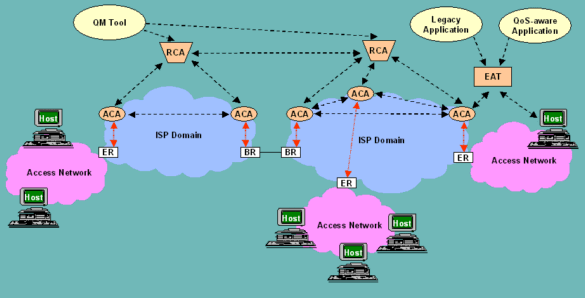
see also Standardization Activities
Contacts: Hermann Granzer, SAG; Iakovos Venieris, NTU

QoS Traffic Studies and Engineering:
Contents:
|
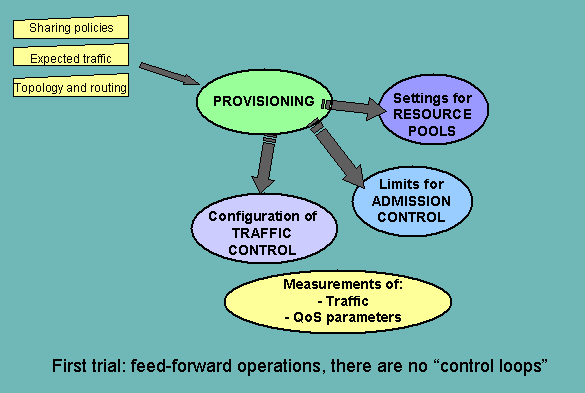
The innovative architectural concepts require novel algorithms for traffic control, admission control and traffic engineering in order to optimize the network performance and achieve efficient usage of the network resources. A goal of the project is to define a clear reference framework to operate with the different facets of traffic handling in a consistent way. Traffic handling is used here as a general term for a set of coordinated mechanisms that operate at different time scales:
A simplified pictorial view of the relationships between the different mechanisms as defined for the first phase of the AQUILA project is shown in the following picture.
|
|
 |
|
|
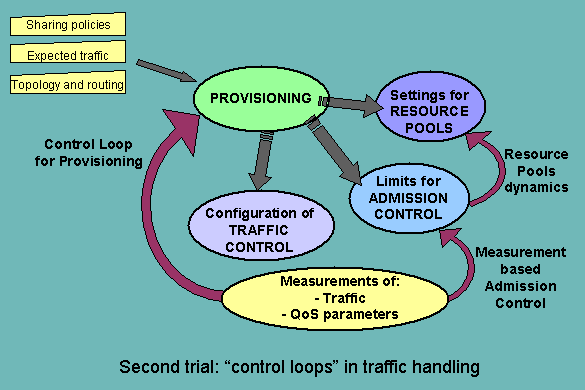
The first trial specification of traffic handling mechanisms foresees feed-forward operations, i.e. there are no automatic control loops from the measurements into the operation of traffic handling mechanisms. The second trial specification introduces feedback at different levels as depicted in the following picture.
|
|
 |
|
|
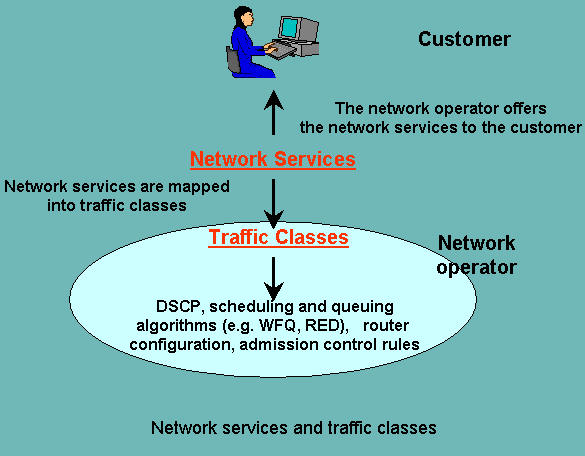
A set of Network Services have been pre-defined in the AQUILA project, which represent the services sold by the provider to its customers: Premium Constant Bit Rate (PCBR), Premium Variable Bit Rate (PVBR), Premium Multimedia (PMM), Premium Mission Critical (PMC) and Standard Best Effort (STD). Each Network Service is meant to support a class of applications with substantially similar requirements and characteristics. The Network Services are internally mapped by the operator into a set of Traffic Classes. The Traffic Classes use DiffServ based packet handling mechanisms and are defined in terms of queuing and scheduling mechanisms in the routers.
|
|
|
|
Contact: Stefano Salsano, COR
QoS aware Applications and User Services:
Contents:
|
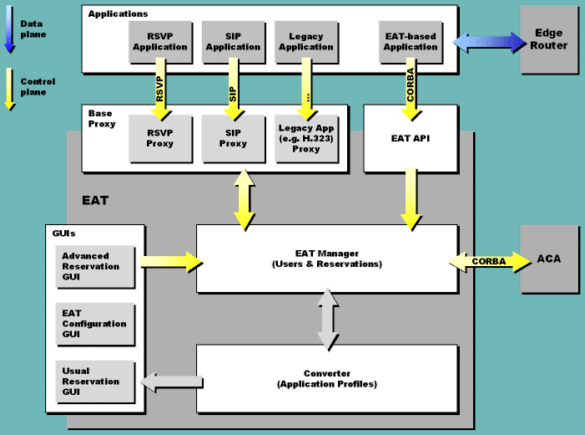
The End-user Application Toolkit (EAT) is a distributed middleware architecture that aims to provide users and applications with access to the QoS facilities of the AQUILA architecture. The EAT specifies the QoS interfaces, both human and programmatic, that users and applications may use in order to get QoS support from the network. Therefore, its main purpose is to bridge the gap between applications/users and the network, playing the role of a QoS portal. The EAT aims to support a variety of application genres and needs. However, it focuses on legacy applications: non QoS-aware applications that cannot be modified to leverage the AQUILA QoS functionality. Specific mechanisms are being developed in order to QoS-enable such applications:
|
|
| The End-user Application Toolkit is also oriented towards the support of new QoS applications. To this end, a QoS API is specified in Java that will expose the EAT components for use by other applications. Since most application developers are not QoS experts, they are expected to benefit from the use of a QoS API, as they will be able to leverage the EAT QoS functionality. |
Contacts: Iakovos Venieris, NTU; Heinrich Hußmann, TUD
Distributed QoS Measurements:
Contents:
- Overview
- Measurement Architecture
- Support for Resource Control
|
Overview Within AQUILA active and passive measurements are performed. Passive measurement (or "monitoring") is a method, where no additional measurement packets are created, active measurement ("probing") uses test packets for measuring the QoS parameters. The results of the measurements are used by the ACA to enable measurement based admission control (MBAC). Additionally application-like load generators measure end-2-end-QoS at the application level to validate the QoS targets for the different network services. Measurement Architecture
| |
|
|
|
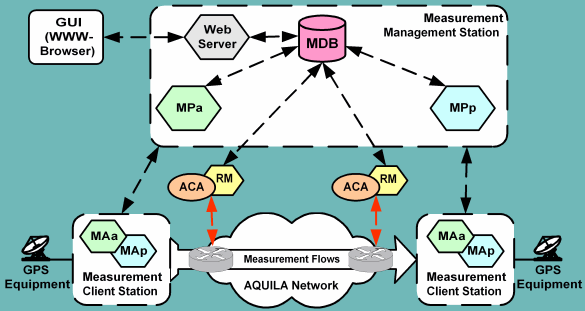
The measurement architecture is divided into two major parts: the measurement management station and several measurement client stations for executing active measurements. The measurement management station is responsible for distributing the test scenarios among the measurement client stations, storing the scenarios and measurement results in the measurement database (MDB) and hosting the web-server for the GUI. Two management processes are running on the measurement management station (MPa, MPp). One for the probing measurement agents (MAp) and one for the application-like measurement agents (MAa). The management processes request the measurement database in regular intervals for new test scenarios and distribute these scenarios to the specified measurement agents. Furthermore, they retrieve the result reports from the measurement agents and write them into the measurement database. To be able to measure exact one-way delays of the measurement packets, the measurement agents use the time information provided by the Global Positioning System (GPS). Therefore the hosts need to be equipped with GPS cards, which are connected to GPS antennas. In the case of monitoring large networks with active network probing, the MPp can be distributed into different network regions. In this case, the measurement agents (MAp) will report the results to the nearest management process, which then reports aggregated results back to the measurement database. The router monitor (RM) uses passive measurements to obtain QoS-related statistics from the router. It distinguishes between core and the edge routers. In the core routers of the network the statistics about traffic classes, into which the flows in AQUILA are mapped, are monitored. At the edge routers of the network each single flow reservation can be monitored. The routers are polled in configurable time intervals. Examples of monitored parameters are the queue lengths, number of conforming / exceeding packets and bytes, number of dropped packets and the average CPU utilization. Support for Resource Control The support for resource control is based on information gathered by the router monitor at the edge routers. This information is used to improve the admission control handled by the Admission Control Agent (ACA) from declarative based admission control (DBAC) to measurement based admission control (MBAC). The MBAC algorithm used in AQUILA is based on the estimation of the mean rate by polling the router in configurable intervals. |
Contact:
Ulrich Hofmann, SPU
Modification: 02/12/2002, Bert F. Koch, © 2000-2003 AQUILA consortium