 |
Introduction
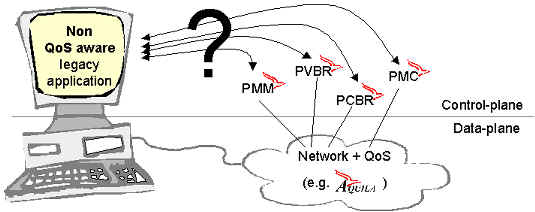
Middleware systems support applications in a distributed environment, serve as the glue between two applications, connect and pass data between two sides of an application. Providing QoS support is one of the features of the new generation middleware systems. QoS support is required by new QoS aware applications as well as for QoS sensitive legacy non-QoS-aware applications like e.g. current VoIP or video-conferencing applications, which properly working is affected by a non-guaranteed and non-predictable best effort network behaviour. In a QoS-enabled scenario, like the AQUILA one QoS is offered at network level but how can a non QoS aware legacy application profit from this QoS offer?
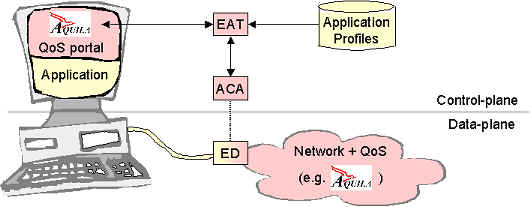
One solution consists in offering the QoS in parallel to application run time via a so-called web QoS portal. In a first step the portal gets the information from the end-user which application he uses. In a second step the so-called EAT provides the QoS portal with the QoS information appropriate to the corresponding application information. Therefore it uses the so-called Application Profiles.
The Application Profile concept is on the one hand
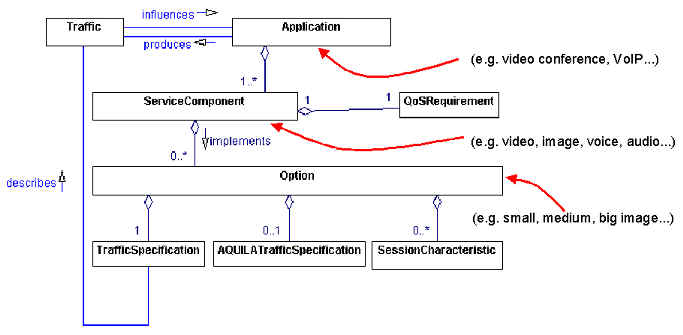
on the other hand a repository of files with the concrete application descriptions. This document presents the specifications of the QoS offer resp. request at different levels used by AQUILA. The aim of the specification is to provide a generic and network independent QoS description language. This aim is not yet completely achieved and, apart from a well-defined component (AQUILATrafficSpecification), all the attributes are generic and network independent. The following picture, an UML analysis class diagram, depicts the relation between the different elements influencing the QoS attributes.
An application can be described hierarchically. It consists of Service Components like video, voice, music, etc. They provide many quality levels, the so-called Options (e.g. big, medium or small picture size), and have a QoS requirement in terms of the QoS parameters delay, jitter, loss, error and throughput. The options are specified by the description of the produced traffic, the TrafficSpecification, the metaphor for the end-user the so-called SessionCharacteristic, and the proprietary AQUILATrafficSpecification.
|
|
Asumptions
|
|
Application Profile The description of applications relies on a formal QoS description syntax, the so-called Application Profile, which can be seen as a framework for application developers. It is based on the assumption that an end-user cannot express QoS in terms of high-complex technical parameters like RSVP, UMTS, etc. The end-user can express QoS via metaphors corresponding to the human senses: sight, hearing, and on the perception of time-related behaviour. User-friendly descriptions for QoS correspond to a universal apprehension of applications and ideally make reference to well-known similar “services” from everyday life like TV, video recorder, Hi-Fi, or phone. Towards the network the Application Profile semantic offers the possibility to support QoS sensitive applications. This enables the application to present the QoS offer from the network to the end-user and to request QoS. An Application Profile is twofold. It defines for an application at end-user as well as application level:
An Application Profile allows on one hand side the precise description of the application's behaviour (how does the traffic, produced by the application, look like; how does the application behave, etc.) with its required QoS parameters (what does the application need from the network in order to work properly), and on the other hand the metaphorical description of the service components with the different quality levels.Beside these two main tasks an Application Profile enables the description of low level information at control plane and data plane level. An Application Profile is specified by a Document Type Description (DTD): ApplicationProfile.dtd. This DTD is not monolithic and refers to a so-called Service Component Profile. With this ApplicationProfile.dtd syntax it is possible to:
|
|
Service Component Profile The Service Component Profile is the central element of the Application Profile and enables the description of concrete service components like voice, video or data. The information that can be described applying the ServiceComponentProfile.dtd syntax corresponds to:
The information can be described in an objective (parameter and value) and subjective (words) manner. A weighting system (from 1 to 10) enables a more precise specification of the QoS requirements and behaviour. A ServiceComponentProfile is specified by a Document Type Description (DTD): ServiceComponentProfile.dtd. Please note that this solution (apart from the AQUILA component AQUILASpecification) is generic. With the ServiceComponentProfile syntax it is possible to:
|
|
Library This library is a living document that benefits from contributions. If you developed applications or profiles based on the previously presented ApplicatioProfile.dtd, we kindly encourage you to send them to Anne Thomas to have them published on this page. For each particluar (non adaptive) application (legacy or QoS-aware) it is possible to create its Application Profile by following the Application Profile DTD. This task has to be done manually. The person creating the profile has to collect all the information necessary to fullfill the DTD schema. Example for a concrete Application Profile:
| ||||||
|
Related work
The activity on Application Profiles (description of application QoS requirements/expectations toward the network from an end-user point of view as well as at application level, and description of the corresponding network QoS offer) lead to a study of QoS description or specification languages presented in the following:
|
Contact:
Anne
Thomas
TU Dresden
Departement of Computer Science
Institute for Software and Multimedia Technology
Software Engineering Group
D-01062 Dresden - Germany

Modification: 06/05/2002, Bert F. Koch,© 2000-2003 AQUILA consortium